

A sales enablement team is the group that equips reps to sell more consistently, then coaches and measures them until the right behaviors stick. The structure question sits underneath most enablement problems. Leaders hire a first enablement person, then a second, then a content specialist, and end up with a function that produces a lot of material without much proof any of it changed how reps sell.
This article covers what a sales enablement team actually does, the core roles, how the structure evolves as you scale, who it should report to, and how to measure whether the structure is working. It’s written for sales leaders, enablement directors, and RevOps teams building or reshaping the function.
Key takeaways
- A sales enablement team exists to change what reps do in live deals, not to produce content. Structure it around behaviors, not deliverables, or it drifts into a content factory with no proof anything changed.
- Most teams run on five roles: enablement leader, content manager, training and onboarding manager, program or field enablement, and enablement operations. Small teams combine several into one person, but each role should still be accountable for a behavior, not an output.
- The right structure scales with rep count, roughly one enabler per 25 to 50 reps, but the ratio is a planning tool, not a law. Harder sales motions need more support per rep.
- Reporting lines are genuinely contested. RevOps ownership is most common (about 39% of organizations), but Sales, the C-suite, and Marketing all pull the function in different directions. Pick the line that counters your team’s likeliest failure mode.
- Measure behavior and outcomes, not activity. Time to productivity, adoption of a target behavior before and after a rollout, and win-rate movement on coached deals are the real signals. Content published and training completion are vanity metrics.
What a sales enablement team actually does
A sales enablement team exists to change what reps do in live deals, not to produce content. That distinction decides everything about how you structure it. A team measured on assets shipped will optimize for volume: more decks, more courses, more one-pagers. A team measured on behavior will optimize for adoption, reinforcement, and the small number of actions that actually move win rates. The org chart you build depends on which of those two jobs you think you’re hiring for.
The shift is already underway across the field. Enablement leaders now name rep productivity, not content creation, as their top priority heading into 2026, with 67% citing productivity as their number one enablement priority. That reframes the team from a content factory into a performance function, and a performance function needs different roles, different reporting lines, and different metrics than a publishing operation does. Keep that lens on as you read the roles below, because each one earns its place by driving a behavior, not by owning a deliverable.
The core roles on a sales enablement team
Most sales enablement teams are built from five roles, though small teams combine several into one person. What matters isn’t the title but what each role is accountable for, framed as a rep behavior rather than an output.
The accountability column is where structure gets honest. A content manager whose success is measured by assets published will flood the team with material. The same role measured by whether reps actually use the material in deals behaves completely differently, and builds far less that nobody opens. Structure the roles around the second version.
For a mid-market SaaS team running a single sales motion, these five roles often compress into two people early on: one owning content and onboarding, one owning field enablement and measurement. The accountability split still matters even when the headcount doesn’t support five distinct hires yet.
How the structure changes as you scale
Sales enablement team structure evolves in predictable stages, and the most common mistake is copying an enterprise org chart onto a team of eight reps. The right structure is the smallest one that covers the behaviors you need reinforced at your current size.
Research bears out the range. Across studies, one enabler typically supports somewhere between 25 and 50 reps. Team-size distribution skews small, with roughly a third of enablement functions being a single person and another third having two to four people.
The ratio is a planning tool, not a law. A team selling a complex, multi-stakeholder product needs more enablement support per rep than one selling a simple transactional deal, because the behaviors that need reinforcing are harder and more numerous. Use the benchmark to project your next hire, then adjust for how hard your sale actually is.
Who a sales enablement team should report to
The reporting line for a sales enablement team is genuinely contested, and the honest answer is that it depends on what you need the function to fix. The field has moved toward RevOps ownership, but no single line dominates. Recent survey data puts RevOps at around 39% of organizations, Sales at about 25%, the C-suite at roughly 17%, and Marketing in the single digits.
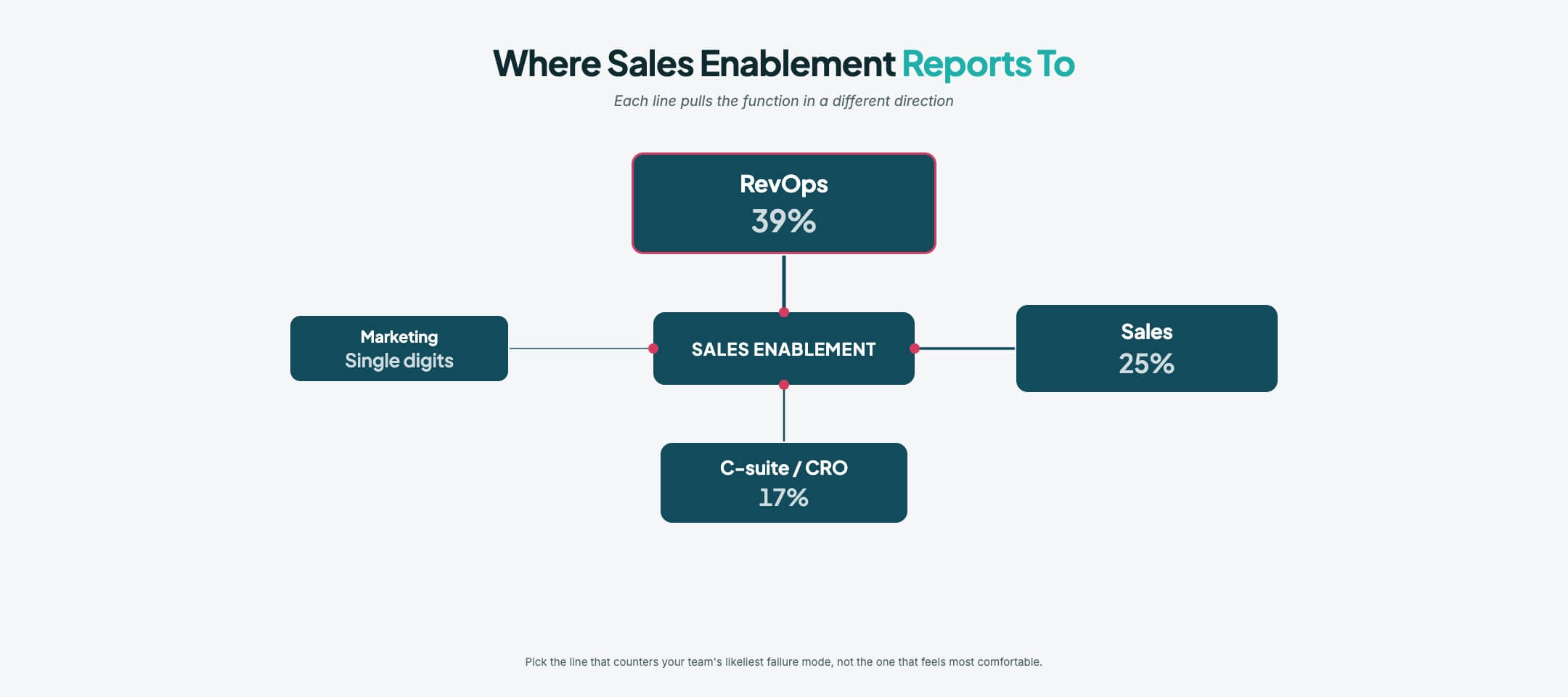
Each line pulls the function in a different direction. Reporting to Sales keeps enablement close to the field and the daily reality of deals, but risks it becoming a reactive request queue for whatever this quarter’s fire is. Reporting to RevOps ties enablement to data and process, which suits a measurement-first team, though it can drift away from the human coaching side if the data becomes the only language.
Reporting to Marketing keeps messaging tight but tends to pull the team back toward content production, which is the exact trap a behavior-focused function is trying to avoid. Standalone reporting to a CRO gives enablement the authority to drive change across both sales and marketing, which is why it becomes more common at enterprise scale. Pick the line that counters your team’s likeliest failure mode, not the one that feels most comfortable.
How to measure whether the structure works
A sales enablement team should be measured on rep behavior and business outcomes, not on how much content it produced or how many sessions it ran. This is where most structures quietly fail, because activity metrics are easy to gather and outcome metrics aren’t. Counting courses built or assets published tells you the team was busy. It says nothing about whether reps changed, which is the only thing the function was hired to do.
Better measures track the distance between training and the field. Time to productivity for new hires shows whether onboarding works. Adoption of a target behavior, measured before and after a rollout, shows whether reinforcement is landing. Win-rate movement on the specific deals where a new play was coached shows whether any of it reached revenue. These are harder to instrument, which is exactly why the enablement operations role exists and why measurement should be built into the structure from the first few hires rather than bolted on later.
The hard part is the last mile: seeing whether a behavior actually stuck once the training ended and the rep was back in a live deal. Classic enablement tools are strong at building and delivering content and weak at that reinforcement loop. This is the gap where visibility and recognition matter, because a behavior that’s seen and acknowledged in the moment gets repeated, while one that disappears into a dashboard nobody checks doesn’t.
Tools like SalesScreen sit in this reinforcement layer, making target behaviors visible on the floor and recognizing reps the moment they perform them, which is the part of the enablement structure that turns a completed training into a changed habit. It’s also why a behavior-focused enablement function pairs its content and training roles with a real coaching and reinforcement cadence, a theme we cover in depth in our breakdown of how to build a sales enablement strategy that changes behavior.
For a regional bank running enablement across a dozen branch teams, this is usually the missing piece: the content and training exist, but nobody can see whether a coached behavior, like a specific cross-sell script, actually shows up on calls three weeks later. Visibility closes that gap without adding another report to build.
Common structural mistakes
Most broken sales enablement teams share a handful of structural flaws, and naming them makes them easier to avoid.
The most common structural failure is a content factory with no reinforcement loop, where the team ships material at volume but nothing checks whether reps use it or whether the trained behavior survives contact with a real deal.
Enablement becomes an ops dumping ground when it reports into a function that hands it every unowned task, so it turns into a catch-all and loses the focus that behavior change requires.
Priorities scatter when there’s no clear owner, because splitting enablement informally across sales managers and marketing leaves no one accountable and nothing sticks.
A structure that never scales past the first hire stalls the whole function, since one overloaded generalist can launch enablement but can’t sustain it, and failing to add the second and third role at the right ratio burns that person out.
Where to start
Start with one hire and one clearly defined behavior you want to change, not with an org chart. The first enablement person should own the highest-impact behavioral outcome you have, usually new-hire ramp or a specific deal-stage weakness, and be measured on that outcome rather than on output.
Build the measurement in from day one so the function can prove its worth and justify the next hire. Then add roles against the ratio as the rep count grows, keeping every new role tied to a behavior it’s accountable for. A sales enablement team structured this way stays small, focused, and provable, which is what keeps it funded and what keeps it actually changing how your reps sell.
Frequently asked questions
What is the difference between sales enablement and sales operations?
Sales enablement builds rep capability, while sales operations builds the systems reps run on. Enablement owns training, content, coaching, and the behaviors that show up in deals. Operations owns CRM, tooling, territory design, forecasting, and process. They overlap on data and often sit under the same RevOps leader, but they solve different problems and shouldn’t be collapsed into one role. For more on where the two intersect day to day, see our guide on how to manage a sales team.
What is the difference between sales enablement and revenue enablement?
Sales enablement focuses on the sales team, while revenue enablement extends the same discipline across the full revenue org. Revenue enablement covers SDRs, account executives, customer success, and sometimes partners, aligning every customer-facing role around consistent behaviors. Many teams rename the function as they scale past a single sales motion, though the core job of changing behavior and proving it stays the same. Our sales enablement strategy guide covers how that discipline holds up across both versions.
When should you hire your first sales enablement person?
Hire your first sales enablement person when onboarding starts breaking down or when top-rep behaviors stop spreading on their own, usually somewhere between 20 and 40 reps. Below that, a sales manager can often carry enablement informally. The trigger isn’t a headcount milestone but a symptom: new reps ramping slowly, or a widening gap between your best and average performers, which is also one of the earliest signals of sales team retention risk worth watching.
What skills should a sales enablement manager have?
A sales enablement manager needs three core skills: selling credibility so reps trust them, instructional design so training actually sticks, and data fluency so they can prove impact. Data fluency is the most underdeveloped and the most valuable, because without it the function can’t show which behaviors moved revenue. Strong project management matters too, since most of the job is coordinating rollouts across teams. Our sales enablement strategy guide breaks down how these skills translate into an actual rollout plan.
What KPIs should a sales enablement team track?
A sales enablement team should track behavior and outcome KPIs, not activity counts. The core set is ramp time to productivity, adoption of a target behavior before and after a rollout, and win-rate movement on the specific deals where a play was coached. Avoid vanity metrics like content published or training completion, since they show the team was busy without showing reps changed. See our broader guide on how to manage a sales team for how these KPIs fit into a manager’s regular cadence.
