

Most sales pipelines have stages. Far fewer have stages that actually mean anything. One rep marks a deal “proposal” when they email a quote, another when the buyer verbally agrees to see pricing, a third when procurement is already involved. The label is the same, so the pipeline looks orderly on a dashboard, but underneath it the stages describe three different realities. That gap is why so many forecasts are fiction and so much coaching arrives too late.
Sales pipeline stages exist to make deals visible, giving everyone a shared, observable definition of where a deal really is and what happens next. This article covers what a pipeline stage is, the standard stage model, and why exit criteria create visibility. It also covers how many stages you need and how to read the pipeline once the stages are trustworthy. It’s written for sales leaders and managers fixing a pipeline.
Key takeaways
- A pipeline stage is only real if it’s defined by an observable event, not a rep’s gut feeling. Sentiment-based stages create a pipeline that only looks visible.
- Most B2B teams need five to seven stages. Each one should have a distinct exit event and change how you’d coach the deal, or it should be merged with a neighbor.
- Exit criteria are what make forecasting trustworthy. Undefined stages are one of the main reasons only 7% of companies achieve forecast accuracy above 90%.
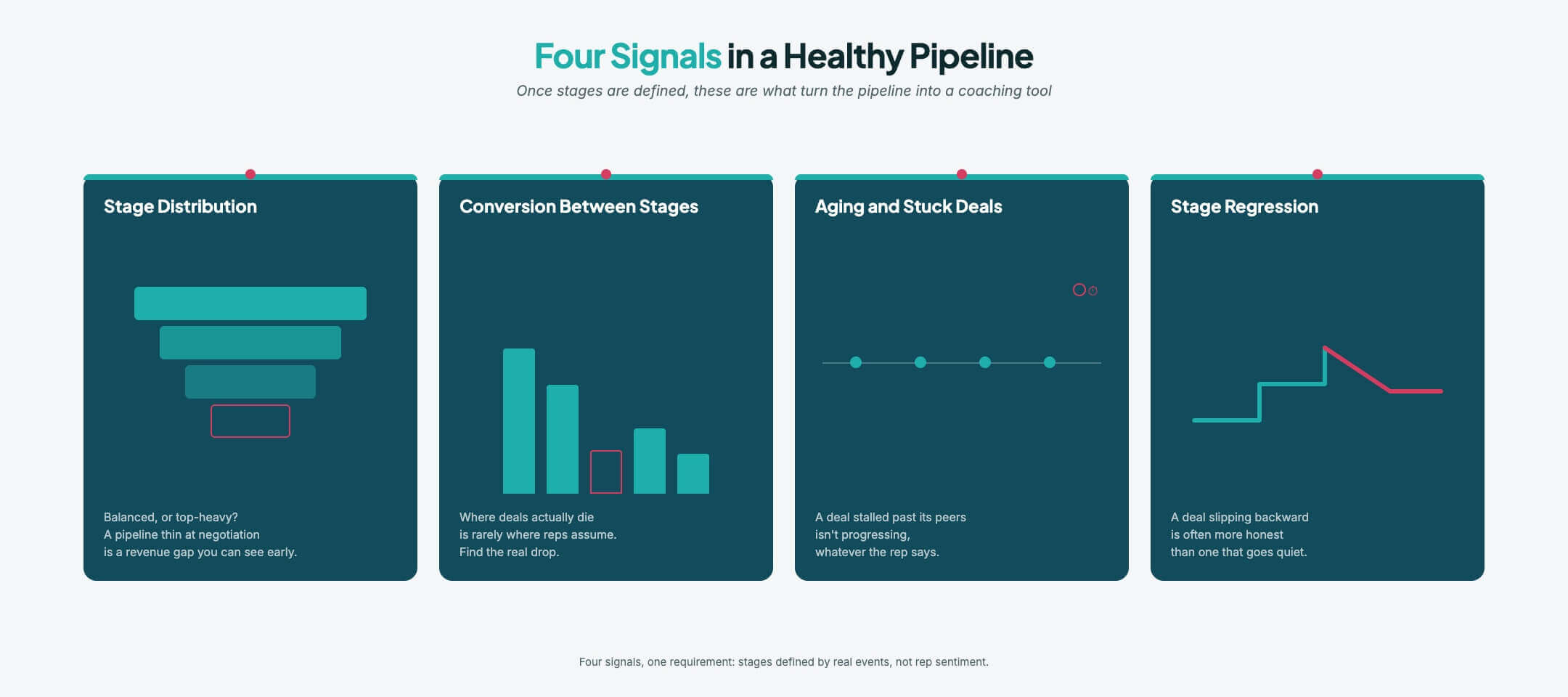
- Once stages are defined, four signals turn the pipeline into a coaching tool: stage distribution, conversion between stages, aging and stuck deals, and stage regression.
- Stage hygiene decays without visibility and recognition. A rep who sees their own progression and gets recognized for clearing a real exit event has a reason to keep the data honest.
What sales pipeline stages are and the standard model
What counts as a stage
A sales pipeline stage is a defined checkpoint in the buying process with clear criteria for entering and leaving it. The key word is defined. It’s not a rep’s gut feeling about how a deal is going, and it’s not a probability someone assigns to make the forecast look reasonable. It’s a factual statement about where the buyer is, backed by something observable that either happened or didn’t.
That distinction is the whole game. When a stage is defined by an observable event, anyone can look at a deal and agree on where it sits. When it’s defined by rep sentiment, the pipeline becomes a collection of private opinions only the individual rep can interpret.
The first kind of pipeline is visible. The second only looks visible, which is more dangerous, because leaders trust a number that has no shared meaning underneath it.
The standard six-stage model
Most B2B teams run some version of a six-stage model, from first contact to closed deal. The exact names vary, but the backbone is consistent, and what matters isn’t the label on each stage but the observable event that marks its exit.
Read the exit-criteria column, not the stage names. Each one is an event you could confirm by looking, not a mood you’d have to ask the rep about. That’s the difference between a stage model that creates visibility and one that just organizes optimism into columns.
Why exit criteria are what make a pipeline visible
Exit criteria are the single feature that turns a list of stage names into a visible pipeline. Without them, a stage is just a label a rep applies at their own discretion, and every rep applies it differently. With them, a stage is a claim anyone can verify, so the pipeline finally says the same thing to the rep, the manager, and the forecast.
The forecasting cost of skipping them
The cost of skipping this shows up directly in forecasting. When one rep marks proposal early and another marks it late, the model is averaging two incompatible definitions, and the output is noise dressed as precision.
Gartner has found that improving CRM data hygiene, which starts with defined stages and consistent progression, can lift forecast accuracy by up to 30%. The reverse is the more sobering number: only 7% of companies achieve forecast accuracy above 90%, and undefined stages are one of the main reasons.
Visibility also compounds. Teams that review the pipeline on a regular cadence, which is only possible when the stages mean something, hit 87% forecast accuracy versus 52% for teams that track irregularly. Get the exit criteria right and every downstream metric becomes trustworthy. Get them wrong and no amount of dashboard polish will save the forecast.
How to design and read your pipeline stages
Choosing how many stages you need
The right number of pipeline stages is the smallest number that captures how your buyers actually move, usually between five and seven. More stages don’t mean more visibility. They mean more places for a deal to sit ambiguously, more fields for reps to update, and more chances for two people to disagree about where something belongs.
The test for whether a stage earns its place is simple. Does it have a distinct exit event a deal must clear to move on, and does knowing a deal is in that stage change what you’d do about it? If two adjacent stages share the same exit event, or you’d coach a deal the same way in both, they should be one stage.
Complexity should match your sale. A transactional deal that closes in two calls doesn’t need discovery and negotiation as separate steps. An enterprise deal with a security review, procurement, and five stakeholders might need both, plus a distinct stage for legal. For a mid-market SaaS team splitting SDR and AE motions, the SDR side of the pipeline often needs only two or three stages before handoff, while the AE side needs the full model. Build around the real shape of your buying process, then stop adding stages the moment they stop changing your decisions.
Reading the pipeline: four signals
Once stages are defined by observable events, the pipeline becomes a coaching tool rather than a status report, and four signals do most of the work.
Stage distribution shows whether the pipeline is balanced or top-heavy. A pipeline stuffed with early-stage deals and thin at negotiation is a future revenue gap you can see months out.
Conversion between stages shows where deals actually die, and the drop is rarely where reps assume. Industry benchmarks put opportunity-to-close at around 31% for enterprise and 39% for SMB deals, so knowing your own stage-to-stage rates tells you which transition is costing you most.
Aging and stuck deals flag a deal that sits in one stage far longer than its peers, whatever the rep says about it. Deals that stall in proposal beyond three weeks convert at a fraction of the rate of ones that move.
Stage regression is the fourth signal, when a deal slips backward. It’s often a more honest indicator of trouble than a deal simply going quiet.
Keeping stage data honest
The hard part is that this reading only works if reps keep the stages current, and stage hygiene is where most pipelines rot. A stage a rep updates once a week, under pressure and out of obligation, drifts back toward fiction.
This is where visibility and recognition matter. A rep who sees their pipeline progression on a shared screen, and gets recognized the moment a deal clears a real exit event, has a reason to keep the data honest. Tools like SalesScreen sit in this layer, making stage progression visible and turning a clean pipeline update into a recognized moment rather than a chore. That’s what keeps the data trustworthy enough to coach from.
For a regional bank running pipeline reviews across a dozen branch teams, this is often the missing piece. The stage model can be perfectly defined on paper, but if no one can see progression in real time across branches, the same drift creeps back in within a quarter.
Common mistakes and where to start
Common stage design mistakes
Most broken pipelines share the same handful of design flaws, and each one quietly destroys visibility.
The most common mistake is building stages around rep activity instead of buyer behavior, so a stage like “demo given” describes what the seller did rather than where the buyer is. A close cousin is adding too many stages in the belief that granularity equals insight, when every extra stage is another place for deals to sit ambiguously.
Many pipelines also have stages with no exit criteria at all, which leaves progression entirely to rep discretion and makes the model unverifiable. Plenty more treat the stage model as set-and-forget, so it never gets audited against how buyers actually move and slowly drifts out of sync until nobody trusts it.
Where to start
The way out starts with writing down the exit criteria for each stage you already use, then checking whether your reps would all agree on them. Most teams discover here that two or three stages mean different things to different people, which is the root of their forecasting trouble. Fix those definitions first, before touching anything else, because a clean stage model is the foundation every pipeline metric depends on.
Once the definitions are shared, audit your live deals against them and move each one to the stage its actual exit events support. The pipeline will look worse for a week, because you’re replacing optimism with reality. That corrected picture is the first genuinely visible pipeline the team has had, and it’s the one worth coaching from.
Frequently asked questions
What are the 5 stages of a sales pipeline?
A simple five-stage sales pipeline runs prospecting, qualification, proposal, negotiation, and closing. Larger B2B teams often split a discovery stage out of qualification, making six. What matters more than the count is that each stage has a clear exit event, so a deal only advances when something observable has actually happened. Getting this right is also foundational to tracking sales velocity accurately, since velocity calculations depend on knowing exactly when a deal moved.
How many stages should a sales pipeline have?
A sales pipeline should have the fewest stages that capture how your buyers actually move, usually five to seven. Each stage must have a distinct exit event and change how you’d coach the deal, or it should be merged with its neighbor. A transactional sale needs fewer stages than a complex enterprise deal with procurement and legal steps, a distinction that also shapes how a broader B2B SaaS sales operations structure gets built around the pipeline.
What’s the difference between a sales pipeline and a sales funnel?
A sales pipeline tracks individual deals through the stages a seller manages, while a sales funnel describes the aggregate flow of leads narrowing toward customers. The pipeline is deal-level and action-oriented, showing what to do next on a specific opportunity. The funnel is a volume-and-conversion view used for planning. Teams need both, for different jobs, and increasingly rely on AI in sales pipeline management to keep the deal-level view current without manual upkeep.
How do you improve conversion rates between pipeline stages?
Improve stage conversion by first finding the transition where deals actually die, then fixing the specific cause rather than pushing harder everywhere. Common culprits are weak qualification letting bad deals in early, and proposals that stall because stakeholders were never mapped. Track time in each stage, since deals that linger convert at far lower rates and signal a process gap, which is one of the clearest ways to catch a slipping sales velocity trend before it hits the forecast.
What is stage regression in a sales pipeline?
Stage regression is when a deal moves backward to an earlier stage, usually because a new obstacle surfaces or an assumed step turns out to be incomplete. It’s often a more honest signal of trouble than a deal that simply goes quiet, because it reflects a real change in the deal. Tracking regression helps managers spot at-risk deals that still look active, and it’s exactly the kind of pattern AI in sales pipeline management is built to catch before a manager would notice it manually.
