
Choosing sales performance management software is less about features and more about behavior. This guide reframes what “best” means and gives you a practical set of criteria for picking a platform that changes how your team performs, not just how you measure it.
Open up any “best sales performance management software” list and you’ll see the same names in a slightly different order. They calculate payouts, model territories, and reconcile quotas, and the good ones do it well. But if your numbers are already solid and your finance team can run comp, a better calculator isn’t what stands between your team and a better quarter.
Most performance programs underdeliver not because the math was wrong, but because the system never changed what reps did on a Tuesday afternoon. Targets got set, dashboards got built, reports went out on Friday, and behavior stayed put. The software measured performance beautifully and reinforced none of it.
So the real question isn’t which tool has the longest feature list. It’s which one actually moves the number, and that comes down to reinforcement: the visibility, coaching, and recognition that turn a target into daily action. Get it right and the rest of your stack works harder. Get it wrong, and you’ve bought a precise way to watch the quarter slip.
Key takeaways
- The category confuses two very different products under one label: finance-grade incentive compensation management (ICM) platforms that calculate payouts, and performance layers that create real-time visibility, coaching, and recognition. Decide which job you’re solving for first.
- Software moves the number when it reinforces the right behavior daily, not when it reports on it after the fact. Judge shortlists by reinforcement, not by feature counts.
- The seven criteria that matter most: real-time visibility reps actually use, a path for the middle 60%, coaching on current data, recognition built in, daily adoption you can count on, a healthy relationship with measurement, and an honest fit with your comp stack.
- AI is worth paying for only when it shortens the loop between a signal and a coaching action, not when it’s another forecasting engine.
- If comp calculation is your problem, buy an ICM tool. If performance is your problem, reinforcement is the buying criterion.
What “sales performance management software” actually covers
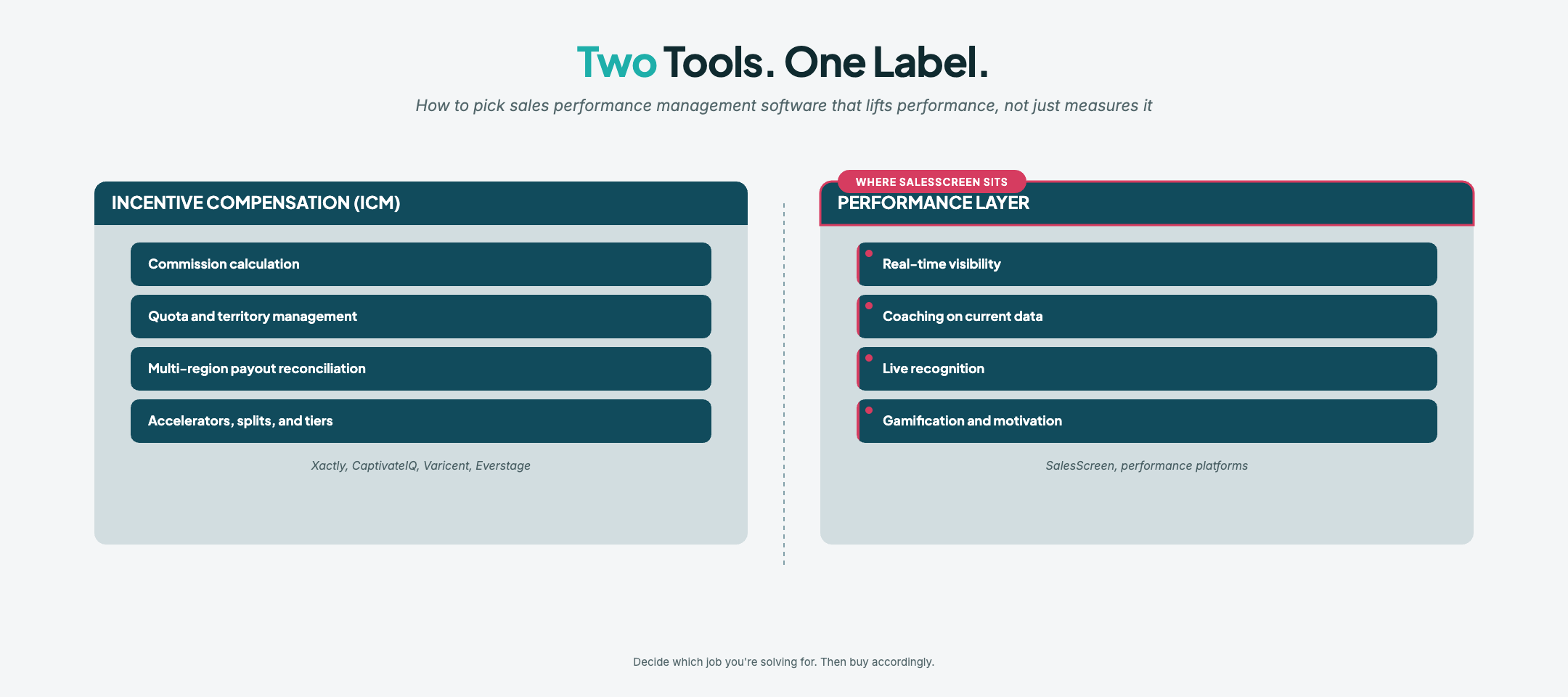
Part of what makes this category confusing is that two very different products wear the same label.
Gartner describes sales performance management as a suite of applications for administering commission-based incentive plans, with seat-based access for sales ops, frontline leaders, territory managers, and finance. That’s the world of Xactly, CaptivateIQ, Varicent, and Everstage. These are powerful, finance-grade systems, and if your comp plans have tiers, accelerators, splits, and multi-region payouts that take days to reconcile, you genuinely need one.
The second is the performance layer that sits on top: the part reps and managers touch every day, the live view of where everyone stands, the midweek coaching, the recognition that makes good behavior repeat. Commission tools mostly treat this as out of scope, assuming that once the plan is right and the payout accurate, motivation takes care of itself.
It doesn’t. A perfectly calculated commission tells a rep what they earned last month. It says nothing about whether they’re on pace today or what their best teammate did differently this morning. That gap is where performance is won or lost, and most buying guides skip it because the tools they rank don’t fill it.
So the first decision is which job you’re solving for. If it’s comp accuracy, shortlist the ICM platforms. If it’s performance, the criteria below are how you find the right tool.
Why most performance programs stall, and it isn’t the strategy
Walk into almost any sales org and you’ll find a reasonable strategy. The targets make sense; the KPIs are defined; there’s a dashboard or three. What’s missing is the operating layer that turns all of that into consistent daily action.
This is the difference between measurement and reinforcement. Measurement tells you what happened. Reinforcement changes what happens next. A team can have flawless measurement and still drift, because data that arrives after the fact can’t influence a decision already made. When the only feedback is a Friday report, the week is already over.
You see it most clearly in how incentives play out. Week one, energy is high, and activity climbs. By week six, the novelty has worn off, the same top performers are winning, and the middle of the pack has checked out. The problem was never the idea. Nothing reinforced the behavior between the kickoff and the payout.
This matters more now than it used to. Gartner’s 2025 survey of chief sales officers found that sales organizations went through an average of 4 transformations in a single year. New motions, new roles, new tools, all landing on the same reps. In an environment moving that fast, a system that only reports outcomes is always describing a world that has already changed.
For the strategic version, our take on building a sales performance management system covers how goals, coaching, and recognition fit together as one operating rhythm. The short version for a buying decision: judge software by whether it reinforces, not just whether it records.
What to look for in sales performance management software
Think of this less as a feature checklist and more as questions for any platform on your shortlist. The features show up in every demo. Whether they change behavior is what you probe for.
Real-time visibility reps actually use
Most dashboards get checked on Monday and ignored until the next one. Look for a live view a rep would open on their own because it tells them where they stand against today’s target, not last week’s. The test: would a rep open this without being told to? If not, you’ve bought a reporting tool. This look at how real-time sales data helps reps covers the mechanics.
A path for the middle 60 percent
Top performers get attention because they’re already winning. Strugglers get coaching because they have to. The middle, the largest and most coachable group, usually gets neither. The best platforms make top-rep behavior visible and copyable. Ask any vendor how their tool helps a middle performer improve, specifically. Vague answers are a red flag.
Coaching that runs on current data
Coaching is the highest-impact thing a manager does, but only when it’s grounded in what’s happening now. Look for a tool that surfaces early signals, a dip in activity, a slower follow-up rate, in time to act, rather than one that confirms a missed quota after the fact. Our rundown of sales coaching techniques goes deeper on building that into a weekly rhythm.
Recognition built in, not bolted on
Recognition is the cheapest motivator available and the most neglected. Most cultures save it for the finish line, which quietly tells everyone who didn’t win to stop trying. Look for a platform that makes it easy to recognize progress and behavior close to the moment it happens, because recognition that arrives weeks later barely registers. Our guide to how to motivate a sales team covers motivation that holds versus motivation that fades.
Daily adoption you can count on
This quietly decides whether any of the others matter. The most sophisticated platform is worthless if reps won’t open it. Ask for real adoption rates and time-to-active-use, not setup time. Adoption is also the cleanest signal that a platform reinforces behavior rather than surveilling it, because reps don’t voluntarily return to something that only watches them.
The right relationship with measurement
You still need solid metrics underneath. Look for a platform that helps you focus on a handful of leading and lagging indicators rather than drowning the team in data, and that treats those metrics as the input to coaching and recognition, not the output of a report. Our guide on how to measure sales performance covers choosing metrics that drive action.
An honest fit with your comp stack
If your compensation is genuinely complex, accept that incentive calculation is a separate job, often a separate tool. A reinforcement-focused performance layer and a finance-grade commission engine aren’t competitors. They solve different problems and often run side by side. What you want to avoid is buying a commission calculator and expecting it to lift motivation.
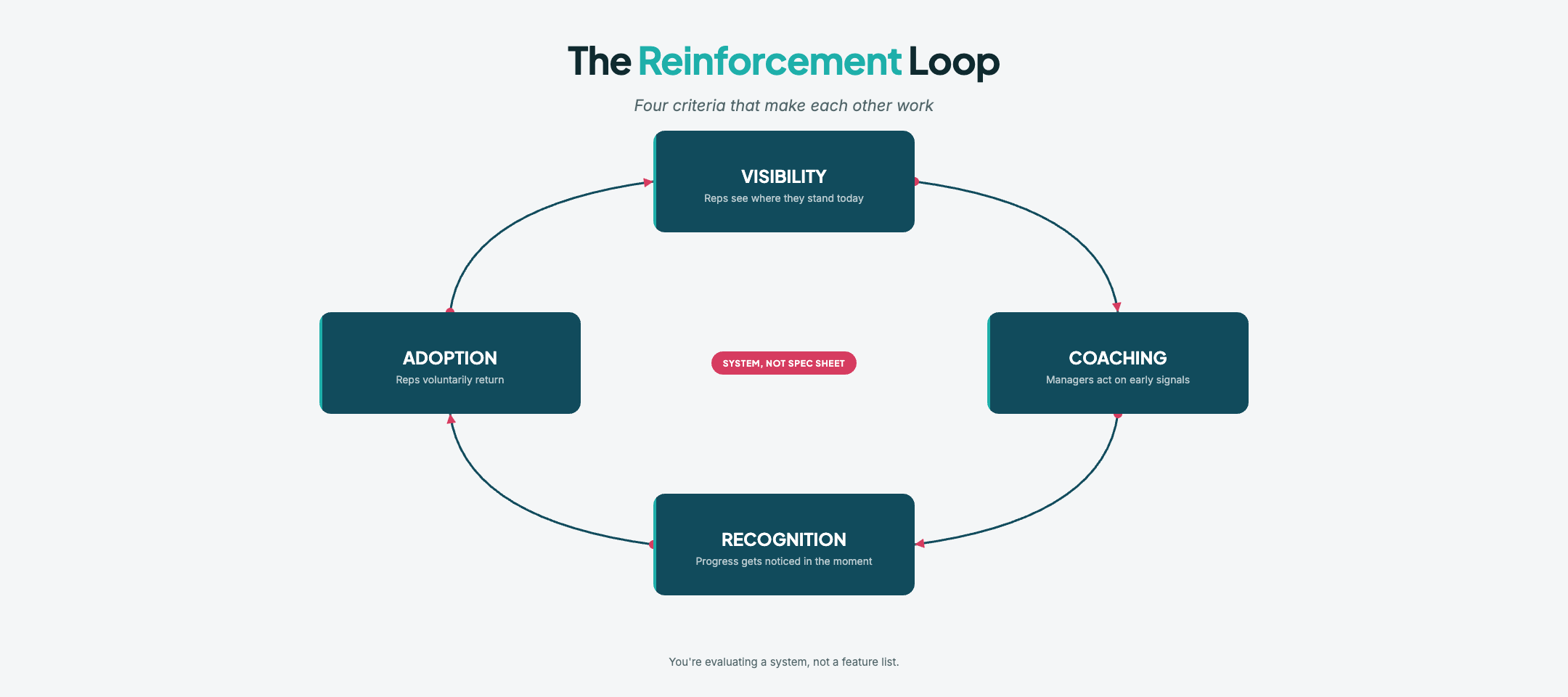
These aren’t independent features. Visibility makes coaching possible, coaching and recognition make visibility motivating, and adoption keeps the loop running. You’re evaluating a system, not a spec sheet.
Put AI to work on reinforcement, not just reporting
Vendors lead with AI-powered forecasting and predictive scoring, which is really measurement with a faster engine. It tells you what’s likely to happen, not what to change this afternoon.
Gartner found that AI now saves sellers nearly five hours a week, yet most sales organizations fail to reinvest that time into high-value selling. The savings are real, the performance gain mostly isn’t, because the hours leak away instead of going into the behaviors that move deals. As Gartner’s Dan Gottlieb put it, AI is the accelerant, not the hero. Teams that do reinvest the time are far more likely to beat their growth and conversion goals.
So the question to ask a vendor isn’t whether the platform has AI. Everything has AI now. The question is whether the AI shortens the loop between a signal and a coaching action. Useful AI does the work a manager has no time to do by hand: it watches every rep’s activity, flags the one whose follow-up rate just dropped, surfaces what today’s top performer did differently, and points the manager toward the conversation that matters most this week. That’s reinforcement at a scale no human can manage by hand.
What AI shouldn’t do is replace the human part. Recognition, coaching judgment, and the read on why a rep is struggling still belong to the manager. The platforms worth shortlisting use AI to make those human moments faster and better targeted, not to automate them away. The AI surfaces the signal and the manager supplies the response, which keeps reps trusting the system instead of feeling watched by it. SalesScreen’s Scout AI is built for that job, reading patterns across rep activity and pointing managers to the moments where their attention will change an outcome.

Where this looks different by team
The criteria hold across the board, but what they emphasize shifts with the shape of your org. A multi-location insurance agency feels the visibility problem most, with teams spread across offices keeping their own dashboards and recognition trapped inside branches, so the priority is a shared, real-time view across locations. A bank running 60 to 80 users has the opposite version: the KPIs are well defined, but execution drifts region to region, so the value is reinforcement that holds one standard everywhere. A mid-market SaaS team on manual SPIFFs feels the gap in real time, as the SPIFFs fade after a week and ramp drags, which is where a well-designed sales incentive program earns its keep by rewarding the behaviors comp doesn’t reach. The need is the same in every case. Visibility, coaching, recognition, and motivation aren’t solved by a better calculation. They’re solved by a system reps want to use.
Where SalesScreen fits
To be straight, SalesScreen isn’t a commission engine. If comp calculation is your core problem, an ICM platform is the right buy. SalesScreen is the performance, motivation, and reinforcement layer that sits alongside your CRM and comp tools.
It pulls data from your existing CRM, with native Salesforce and HubSpot integrations, and surfaces it in real time across rep dashboards, team leaderboards, and shared screens. Reps get a live view of where they stand and recognition as milestones happen. Managers get early signals they can coach on this week. The gamification layer connects visibility to motivation directly, with competitions on live data and recognition firing in the moment rather than at quarter-end. Scout AI adds the performance-intelligence layer, surfacing the rep-level signals a manager would otherwise dig for.
That maps directly to the criteria above: make the right behavior visible, reinforce it while it’s still happening, and recognize it so it repeats. The mechanics of building that kind of program, rather than just buying a tool, are in our collection of sales gamification ideas for motivation that lasts past launch week.
The takeaway
The best sales performance management software isn’t the one with the most modules. It’s the one your team opens every day, that makes good behavior visible while there’s still time to repeat it, and recognizes progress instead of only rewarding the finish line. Match the tool to the job. If it’s comp accuracy, buy the commission engine. If it’s performance, look for reinforcement first and let the feature list come second.
Want to see it in practice? See how SalesScreen turns real-time visibility, coaching, and recognition into daily performance, and book a walkthrough for your team.
Frequently asked questions
What is sales performance management software?
It helps sales teams set, track, and improve performance. In the strict market definition, the category centers on administering commission and incentive plans, including quota and territory management. In practice, leaders also use the term for the performance layer that creates real-time visibility, coaching, and recognition. Knowing which job you’re solving for, comp accuracy or behavior change, is the first step in choosing the right tool.
What’s the difference between SPM software and a CRM?
Your CRM tracks what’s happening with customers and deals. A sales performance management platform tracks how your team is performing against goals and reinforces the behaviors that improve those numbers. The CRM is the system of record. The performance layer makes that record visible and motivating in real time.
Do I need SPM software if I already have a commission tool?
Possibly, because they often solve different problems. A commission tool calculates payouts accurately but does little to change daily behavior between the start of the plan and the payout. If your challenge is motivation, consistency, ramp, or middle-performer growth, a reinforcement layer fills a gap the commission tool was never built to address.
Does the AI in these platforms actually matter?
It depends entirely on what the AI does. AI that only forecasts or scores is measurement with a faster engine. The AI worth paying for shortens the loop between a signal and a coaching action: flagging the rep who slipped this week, surfacing what a top performer did differently, pointing a manager to the conversation that matters now. Treat AI as a reinforcement accelerant, not a checkbox.
How do I know if a platform will actually get used?
Ask vendors for real adoption rates and time to active use, not just ease of setup. A demo always looks polished. What you want to know is how a 30- or 80-person team behaves three months after go-live. Sustained usage is the clearest signal that a platform reinforces behavior rather than simply monitoring it.
Is gamification just leaderboards and badges?
Done poorly, it is, and it fades within weeks. Done well, gamification makes progress visible and reinforces the behaviors that lead to results, rewarding the right activities rather than only outcomes. The platforms worth considering use it to connect daily effort to recognition and motivation, not to turn work into theater.
